Cold-Blooded at the Rack: The Hunter's Guide to Spotting $200 Designer Before the Next Person Touches It

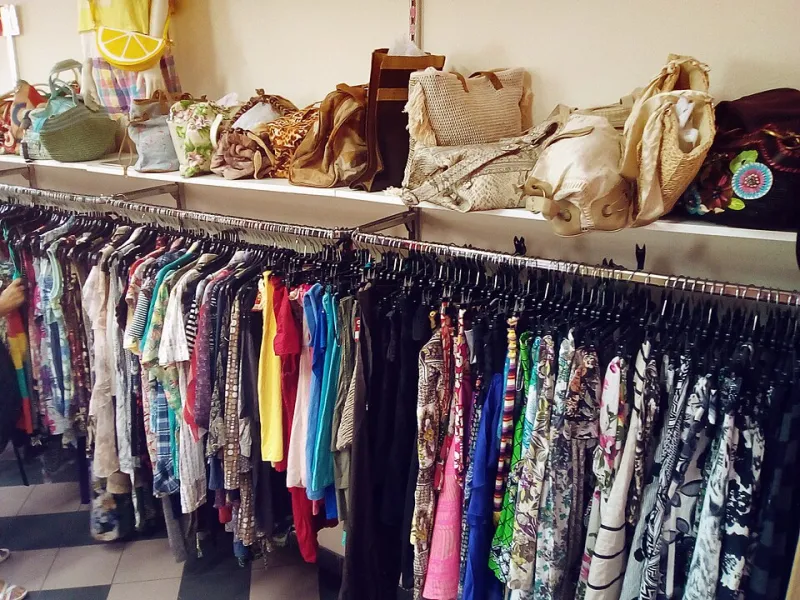
Photo: Jules Verne Times Two, CC BY-SA 4.0, via Wikimedia Commons
Let's get one thing straight before we even walk through those automatic doors: the people who consistently pull $180 Theory blazers and vintage Donna Karan separates out of Goodwill bins are not operating on vibes. They are not spiritually aligned with the secondhand gods. They are not lucky.
They are trained.
Thrift store hunting is an intelligence operation, and most people are walking into it completely unarmed — scanning the racks with the same glazed-over energy they bring to a highway rest stop. Meanwhile, someone two aisles over just quietly tucked a cashmere-blend Eileen Fisher coat under their arm and is already heading toward checkout. That person has a system. This article is that system.
First Rule: Your Hands Are Smarter Than Your Eyes
Before you read a single label, before you squint at a logo or try to decode a care tag, you touch the fabric. This is non-negotiable. The single most reliable tell of a quality garment is how it feels in your hand, and it takes about three seconds to know.
Cheap fabric — the stuff that fills 90% of any secondhand rack — has a specific texture. It's thin, slightly plasticky, and it moves with a kind of reluctant limpness. Quality fabric has weight. Real wool has a density to it. Silk has a cool, almost liquid slip. Heavy cotton has a satisfying firmness. When you run your thumb across the surface of a genuinely well-made piece, there's a resistance there, a substance, that fast fashion simply cannot fake at scale.
Train your hands before anything else. Spend a Saturday touching everything at a Nordstrom or Bloomingdale's — not to buy, but to calibrate. You're building a tactile reference library that will serve you for years.
The Label Is a Crime Scene
Once your hands say yes, your eyes move to the label. And this is where most amateur thrifters completely fall apart, because they're looking for the brand name when they should be reading the whole document.
Here's what a quality label actually tells you:
Country of manufacture matters — but not the way people think. "Made in China" does not automatically mean cheap. Plenty of legitimate luxury goods are manufactured in China. What you're actually looking for is specificity. Cheap garments have vague, minimal labeling. Luxury pieces have detailed care instructions, fiber content breakdowns that go to the decimal point ("55% wool, 35% polyester, 10% cashmere" is a real label — "polyester blend" is a red flag), and often a specific region or factory city listed.
The font and printing quality on the label itself is a tell. High-end brands invest in their internal labeling. The text is crisp, evenly spaced, and printed on quality woven fabric — not heat-transferred onto a flimsy strip. If the label looks like it was made on a home printer, the garment reflects that.
Secondary labels are gold. Dry cleaner tags, alteration notes, or department store price tags left inside a garment are like finding a receipt at a crime scene. A Neiman Marcus or Saks Fifth Avenue internal tag tells you exactly what tax bracket this piece came from.
Seams, Stitching, and the Unholy Truth About Buttons
Open the garment. Look inside. This is where the manufacturer's real priorities are exposed, because nobody making cheap clothes bothers to finish the inside beautifully when they know you'll never see it.
Flat-felled seams — the kind that lie completely flat and have no raw edges — are a hallmark of quality construction. French seams, where the raw edge is fully enclosed, are another. If the inside of a jacket looks almost as clean as the outside, you are holding something worth investigating further.
Buttons are a tell that almost nobody talks about. Cheap garments use lightweight plastic buttons that feel hollow when you press them. Quality garments use buttons made from horn, resin, shell, or heavy-weight plastic that has actual density. Press a button between your fingers. If it feels substantial, almost like a small stone, that garment had money spent on it.
Also check the buttonholes. On a quality piece, the buttonhole stitching is tight, even, and reinforced at both ends. On a cheap piece, it's loose, slightly unraveling, and feels like it's one aggressive button-through away from total structural failure.
The Fit Architecture Test
Hold the piece up by the shoulders. Let it hang. Watch what it does.
A well-constructed garment hangs intentionally. The shoulders sit at a deliberate angle. The hem falls evenly. There's a geometry to it — a sense that someone made specific decisions about how this piece would move in space. Cheap garments hang with a kind of defeated randomness. They sag where they shouldn't, bunch where they should lay flat, and generally look like they've given up.
This is especially useful for blazers, structured dresses, and trousers. The internal construction — interfacing, boning, padding — is what creates that architectural hang, and it costs money to do properly. When you see it, you know.
Pattern Matching Is the Final Boss
If a garment has a pattern — stripes, plaid, floral, anything with a repeat — check whether that pattern lines up at the seams. This is one of the most labor-intensive and expensive things a manufacturer can do, because it requires cutting each piece of fabric with the pattern in mind rather than just maximizing yardage.
At a Goodwill in suburban America, a garment with perfectly matched plaid at every seam is almost certainly not from Target. It came from somewhere that charged accordingly for that detail, and now it's on a rack between a novelty Christmas sweater and a pair of cargo pants from 2003. It is yours for $12.99.
The Patience Tax
None of this works if you're thrifting in a hurry. The whole system collapses the moment you're trying to get in and out in twenty minutes. Real thrift hunting requires a specific kind of slow, methodical attention — the kind that lets you actually feel the fabric, actually read the label, actually look inside the seams.
The people who consistently find the good stuff aren't faster than you. They're slower. They're deliberate. They treat every rack like it might be hiding something worth finding, because statistically, it usually is.
Go on a Tuesday morning. Go alone. Put your phone in your pocket. Move through the racks like someone who has absolutely nowhere else to be and absolutely nothing to prove — except that you're about to walk out of here with something incredible for the price of a sandwich.
Because you are. You just needed the manual.