Fashion Archaeology: The Ruthless Science of Pulling Designer Gold from a Sea of Donated Garbage
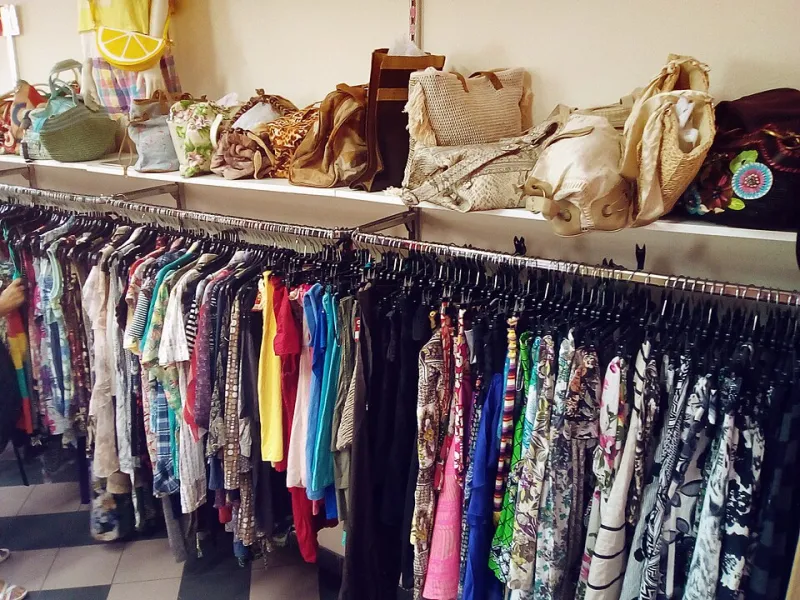
Photo: MAKY.OREL, CC BY-SA 4.0, via Wikimedia Commons
Let's be honest about what's actually happening at your local Goodwill on a Tuesday afternoon. Ninety-five percent of the people in there are grabbing graphic tees and calling it a personality. The other five percent — the quietly intense ones running their fingers along collar seams with the focus of a neurosurgeon — are playing an entirely different game. They are finding the Helmut Lang blazer that some guy's ex-wife donated after she cleaned out the guest closet. They are walking out with a Missoni cardigan for eleven dollars while everyone else argues over which season of Real Housewives that pattern reminds them of.
This is not a luck thing. This is a skill thing. And skills can be learned.
Stop Shopping. Start Investigating.
The first mental shift is the most important: you are not a shopper. You are a fashion archaeologist. Indiana Jones didn't walk into ancient ruins and grab whatever felt cute. He came with knowledge, a methodology, and frankly an unhinged level of commitment. That's the energy.
Designer pieces end up in thrift stores constantly — through estate cleanouts, divorces, closet purges, cross-country moves, and the general chaos of American life. The clothes don't disappear. They migrate. Your job is to intercept them before someone else does, or before they get priced wrong by a staff member who genuinely doesn't know what they're looking at.
The entire operation starts with slowing down. Stop treating the racks like an obstacle course. Start treating them like an archive.
The Fabric Test Is Non-Negotiable
Here's the thing nobody tells beginners: designer clothes feel different. Not in a woo-woo way — in a completely tactile, material science way. Natural fibers and high-quality construction have a weight and drape that synthetic fast-fashion simply cannot replicate, no matter how many trend reports it studied.
Train your hands before you train your eyes. Silk has a cool, almost liquid slip to it. Quality wool has density without stiffness. Real cashmere — not the scratchy impostor stuff — is almost embarrassingly soft and lightweight at the same time. Heavy linen has a texture that's earthy and substantial. When you pick up a blazer and it falls like it has somewhere important to be, that's information.
Conversely, that polyester blouse that feels like a grocery bag in a blazer costume? Back on the rack. Immediately. You have archaeology to do.
Read the Label Like a Text Message That Could Change Your Life
Country of origin labels are your first clue. "Made in Italy," "Made in France," "Made in Japan" — these aren't guarantees, but they're promising starting points. A lot of high-end manufacturing happened in specific countries during specific decades, and knowing that history is like having a cheat code.
Do not sleep on vintage care labels either. Pre-1971 American garments didn't legally require care labels, so if something has no label at all or a very early-format one, you might be holding something genuinely old and potentially significant. Post-1971 labels that list fiber content in specific percentages, or that use older brand formatting, are worth a Google right there in the aisle. Nobody's judging you for standing next to the blazer rack with your phone out. The serious ones are already doing it.
Also: union labels. The ILGWU (International Ladies' Garment Workers' Union) label ran from the 1900s through 1995. The ACWA and UNITE labels have their own timelines. These labels can date a garment precisely, which matters enormously when you're trying to figure out if that structured coat is from a designer's iconic era or a later licensed knockoff.
Construction Details Are Where Liars Get Caught
Flip the garment inside out. This is the move that separates the casuals from the committed. Cheap clothes hide their construction. Quality clothes don't need to.
Look for hand-stitched elements — small, slightly irregular stitches that indicate human hands rather than industrial machines. Check the seam allowances: generous seam allowances mean the maker expected the garment to be tailored and altered, which is a high-end mindset. Examine the lining. A fully lined garment with a quality lining fabric — not that slippery acetate nonsense — signals investment.
Buttons are another tell. Plastic buttons that are lightweight and hollow? Fast fashion. Heavy resin, shell, horn, or metal buttons? Someone spent money here. Even if the label is missing, the buttons are confessing the whole story.
Zippers matter too. A YKK zipper isn't exclusive to designer goods, but a zipper that's been set with precision and sits flat without puckering is a sign of careful construction. A zipper that looks like it was installed during an earthquake is not.
Know Your Brand Histories Before You Walk In
This is the homework portion, and yes, there is homework. The thrift store is an open-book test, but you still have to have read the book.
Spend some time learning which brands had their peak eras when, because a vintage Halston from the '70s and a Halston Heritage piece from 2012 are categorically different objects. Knowing that Donna Karan's DKNY line was more accessible while her main line was luxury-level changes how you assess a label. Understanding that certain Japanese designers — Yohji Yamamoto, Comme des Garçons — have construction philosophies that are immediately identifiable helps you recognize their work even when labels are missing or faded.
Apps like Depop, The RealReal, and even eBay's completed listings are free research tools. Search the brand, search the era, look at what those pieces sell for when authenticated. Then walk into your local thrift store with that knowledge loaded and ready.
The Hustle Is the Point
Here's what nobody in the fast fashion industrial complex wants you to understand: building a genuinely remarkable wardrobe on a thrift budget is one of the most intellectually satisfying things you can do as a person who cares about clothes. It requires you to know things. It rewards curiosity. It punishes complacency.
When you pull a Norma Kamali from 1983 off a rack in a Salvation Army in suburban Ohio and you know exactly what you're holding while the person next to you walks right past it — that feeling is undefeated. That's not luck. That's you having done the work, developed the eye, and shown up ready.
The thrift store doesn't owe you anything. The designer pieces are in there, quietly waiting. They've been handled by people who didn't recognize them, priced by people who guessed, and passed over by people who weren't paying attention.
Be the one who's paying attention. The racks are full of evidence. Go solve something.