The Fit Model Is a Fiction: How to Make Your Body the Blueprint Instead

Somewhere in a midtown Manhattan showroom, a sample size 8 blazer is being draped over a person whose entire professional purpose is to disappear inside it. No personality. No posture quirks. No left shoulder that sits slightly higher than the right because of how they sleep. Just a human coat hanger, calibrated to make a garment look exactly the way a designer imagined it — which is to say, like it belongs on nobody in particular.
That is the fit model. And for decades, the fashion industry has used this fictional baseline to convince you that your body is the problem.
It's not.
The Myth They Sold You at the Dressing Room Mirror
Here's how the con works: a garment is constructed around a set of standardized measurements that represent, at best, a statistical average and, at worst, a completely aspirational fantasy. The fit model exists to confirm that the clothes look "right" before they hit the floor. Then those clothes land in stores, on bodies that are taller, shorter, wider, narrower, longer-waisted, shorter-legged, and infinitely more interesting than any showroom standard — and suddenly you're the one who doesn't fit.
Except you didn't change. The clothes just weren't made for you. They were made for a ghost.
The fashion industry's entire sizing infrastructure is built on the idea that bodies should conform to clothing, not the other way around. And when the blazer pulls across your shoulders or the jeans gap at the waist, the implicit message is that you need to fix yourself. Go to the gym. Try the next size up. Feel vaguely bad about it in a fluorescent-lit changing room while a Zara employee knocks on the door.
This is an elaborate scam. And the boldest thing you can do is refuse to participate.
What "Wrong" Fit Actually Looks Like When You Own It
Let's talk about Rihanna, because we always have to talk about Rihanna. The woman has spent her entire public life wearing clothes that fit her on her terms — oversized bombers swallowing her frame, cropped silhouettes hitting at unexpected places, tailored pieces altered to emphasize exactly what she wants emphasized. She doesn't chase the sample size. The sample size chases her.
Or consider the entire legacy of hip-hop fashion in the '90s, where baggy jeans worn deliberately low and oversized flannels worn open over white tees weren't a fit "mistake" — they were a power statement. The clothes were big because big meant something. It meant freedom. It meant you weren't squeezed into somebody else's idea of how a body should present itself.
Billie Eilish built her early aesthetic almost entirely on deliberately oversized silhouettes — and when the conversation shifted to why, her answer was essentially: because it's mine. The fit wasn't accidental. It was the point.
These aren't people who couldn't find the right size. These are people who decided the "right" size was whatever size they said it was.
The Specific Power of the Awkward Crop
One of the most underrated moves in fashion right now is the accidentally-on-purpose awkward crop. You know the one — a jacket that hits two inches above where it "should," a tee that's been shrunk in the wash until it grazes the ribs at a completely non-standard length, a cardigan that was clearly designed for someone four inches taller and drapes accordingly.
This is not a mistake. This is advanced.
When something hits at an unexpected place, it creates visual interest that a perfectly hemmed, precisely measured garment simply cannot manufacture. It says I know what I'm doing and it's weirder than you expected. It's the sartorial equivalent of a sentence that ends somewhere you didn't see coming.
Thrift stores are full of this kind of opportunity, by the way. That blazer that's a size too small and won't button? Wear it open over a graphic tee. That maxi skirt that was designed for someone with a six-inch height advantage? Belt it, scrunch it, let it drag. The garment's "failure" to fit correctly is actually just raw material.
Baggy in the Right Places Is a Whole Aesthetic
There's a specific kind of style authority that comes from wearing something deliberately, conspicuously large. Not sloppy — large. There's a difference, and it lives entirely in your posture and your commitment.
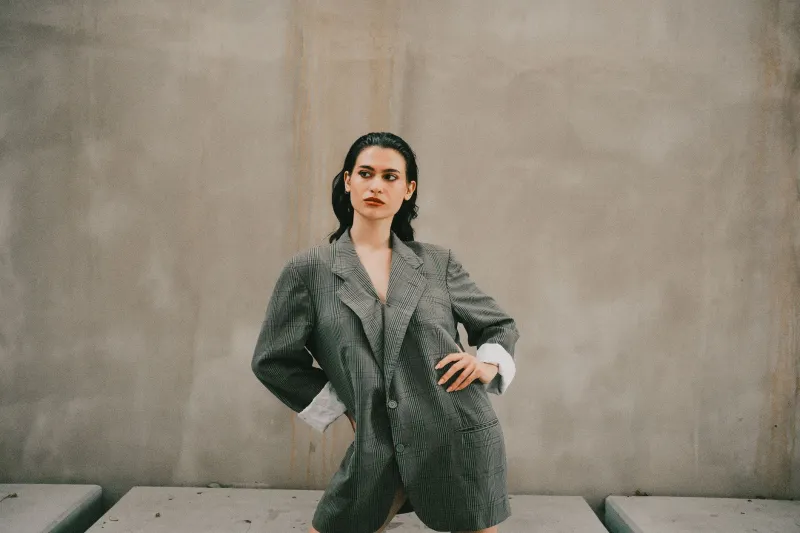
A blazer two sizes up, sleeves slightly too long, shoulders dropping off the edge of yours: that's a look. An oversized white button-down tucked partially into high-waisted trousers with the collar left completely undone: that's a look. Jeans that are wide enough to qualify as a small tent, cuffed once at the ankle with a chunky boot underneath: that is absolutely a look.
The fashion industry will try to sell you "relaxed fit" as a trend category, which is their way of making money off something that people who actually have style have been doing for free forever. Don't buy the trend. Just buy the jeans.
How to Stop Dressing for the Ghost
The practical shift here is less about what you buy and more about how you evaluate what you're wearing. The fitting room question most people ask is: does this fit? The question you should actually be asking is: does this do something interesting on my body?
Those are completely different questions.
"Does this fit" is about conforming to a pattern. "Does this do something interesting" is about using the garment as a tool. Maybe it's interesting because it's enormous and makes you look like you're wearing a building. Maybe it's interesting because it's cropped so short it creates a whole new silhouette. Maybe it's interesting because it fits perfectly everywhere except one sleeve, which is slightly longer, and you've decided that's the whole point.
Your body is not a deviation from the norm. It is the norm — your norm, the only one that actually matters when you're the one getting dressed.
The Fit Model Doesn't Live Your Life
The fit model clocks out. They go home, change into whatever they actually want to wear, and stop being a human measuring tape. Their job is to make clothes look neutral. Your job — if you're reading this website, which you are — is to make clothes look like you.
That requires treating your body not as a problem to be solved by the right size, but as the actual starting point. The blueprint. The authority.
So the next time something fits weird, before you put it back on the rack, ask yourself if the weird is interesting. Ask yourself if the weird is yours. Because the fit model is a fiction, and you are not.
Dress accordingly.