The Capsule Wardrobe Con: Why Owning Less Stuff and Breaking Every Rule Hits Harder Than a Closet Full of Beige
Somewhere around 2015, a very organized, very beige person on the internet convinced millions of Americans that personal style could be achieved through a numbered list. Thirty-seven pieces. A neutral palette. A French tuck. And just like that, an entire generation of otherwise interesting humans started shopping like they were stocking a hotel gift shop.
The capsule wardrobe wasn't a style philosophy. It was a purchasing strategy wearing a philosophy costume.
The Essentials Scam, Explained in One Uncomfortable Sentence
Every time a brand publishes a "wardrobe essentials" guide, they are not trying to simplify your life. They are trying to sell you ten versions of the same white t-shirt and make you feel intellectually superior about it. The genius — and it is genius, in the most diabolical sense — is that they framed unlimited consumption as minimalism. Buy the "right" things, they said. Build a foundation, they said. Then spend the next four years buying slightly different versions of that foundation because this season's "perfect white tee" has a slightly different neckline than last season's "perfect white tee."
You were not building a wardrobe. You were being farmed.
The actual result of the capsule wardrobe industrial complex is a nation of people who own forty-five nearly identical items and still feel like they have nothing to wear. Which is, functionally, the worst possible outcome. You spent the money AND you're still bored.
What the Interesting People Are Actually Doing
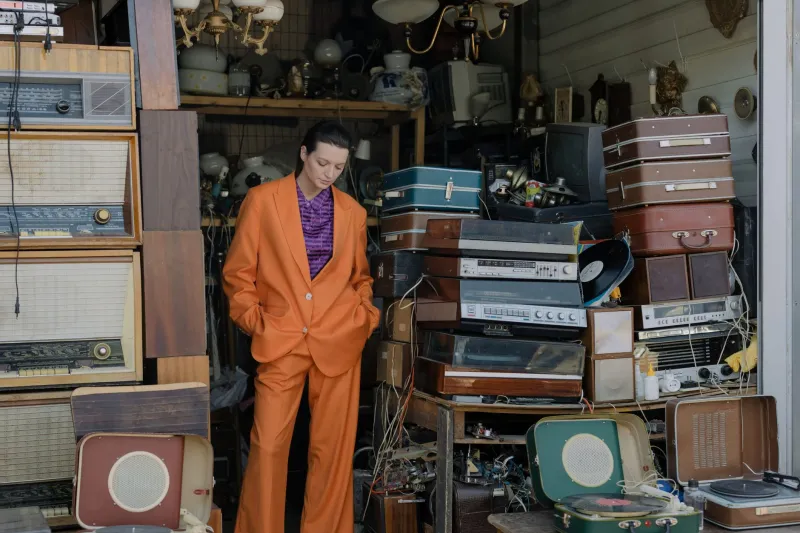
Here's what nobody's Pinterest board will tell you: the most visually arresting people on the planet own a genuinely unhinged number of clothes. Not unhinged as in excessive — unhinged as in weird. Specific. Irreplaceable. They have the vintage Levi's jacket covered in someone else's band patches. The single sequined blazer they wear to the farmer's market, the job interview, and the funeral (different funerals call for different energies). The one pair of trousers so aggressively wide-legged they require their own zip code.
And they wear these things in combinations that make normal people do a double-take at a crosswalk.
The secret isn't volume. It's range. A person who owns eight genuinely strange, deeply personal pieces and knows how to rotate them into forty different combinations is running laps around someone who owns sixty-two "versatile basics" that all look identical in every photo.
More Pieces, Less Personality: The Math Nobody Wants to Do
There's an inverse relationship between how coordinated your wardrobe is and how memorable you are. Think about it. When everything matches, nothing stands out. When your neutrals complement your neutrals and your "statement piece" is a slightly bolder shade of camel, you have successfully blended into the aesthetic wallpaper of modern American life.
Capitalism loves this for you. It means you need more things to feel seen, because no individual thing you own is doing any heavy lifting. The blazer is fine. The pants are fine. The shoes are fine. You are a collection of fine things that adds up to absolutely nothing.
Contrast this with the person who shows up in a $12 thrifted skirt from 1987, a $6 thermal they've worn three days in a row, and a single enormous earring they bought at a gas station in New Mexico. That person lives in your head for a week. You think about their outfit at 2am. You bring it up to your friends. They have achieved something your entire "curated" wardrobe has not: they made you feel something.
The Layering Lie Specifically
Layering deserves its own criminal indictment. The industry's obsession with layering — which began as an actual technique for creating depth and visual interest — has devolved into a content strategy for selling you more stuff to pile on top of other stuff.
Real layering is chaotic. Real layering involves putting a sheer something over a printed something under a structured something and then deciding whether the whole thing works by standing in front of a mirror and trusting your gut. It does not involve buying a designated "layering piece" that was designed to be worn under a designated "over piece" from the same brand's coordinated fall collection.
That's not layering. That's a two-piece set with extra steps and a bigger receipt.
The most interesting layering decisions are the ones that shouldn't work on paper. The leather jacket over the sundress. The hoodie under the blazer. The slip dress worn directly over the chunky knit sweater because you decided the rules about dress-over-pants were worth extending. These combinations don't come from a style guide. They come from someone who looked at their options, got a little reckless, and decided to see what happened.
The Audacity of the Repeat Outfit
Here's a truly radical concept the capsule wardrobe cult accidentally stumbled toward before immediately monetizing it into oblivion: wearing the same thing multiple times is not a failure of imagination. It's proof that you actually know who you are.
The most stylish people in any room are not the ones who never repeat. They're the ones who repeat confidently — who wear the same coat every single day for three winters running because it's the coat and they know it. Who have a signature silhouette they return to constantly, but keep it interesting through the unexpected thing they've thrown on underneath or the completely unreasonable accessory they've committed to.
Repetition isn't boring. Repetition with variation is a power move. It says: I am not scrambling to impress you with novelty. I have a point of view and I'm going to keep making it until you understand.
How to Actually Get Out of the Trap
Stop buying things because they're supposed to work with everything you already own. Start buying things because they're so specifically, aggressively you that you can't leave the store without them. One deeply weird piece that makes you feel something will do more for your style than six responsible basics that make you feel organized.
Ask yourself — before any purchase — whether this thing requires a coordinating piece to be interesting. If the answer is yes, put it back. Interesting clothes are interesting alone. They don't need backup.
And for the love of everything unholy, stop trying to build a wardrobe that makes sense. Wardrobes that make sense produce outfits that are forgettable. Build a wardrobe that makes people ask questions. Build a wardrobe that requires explanation. Build a wardrobe that looks like it belongs to someone who has opinions about things.
The fashion industry will keep publishing its lists of thirty essential pieces. Keep scrolling. The people who are actually worth watching never read the list.